




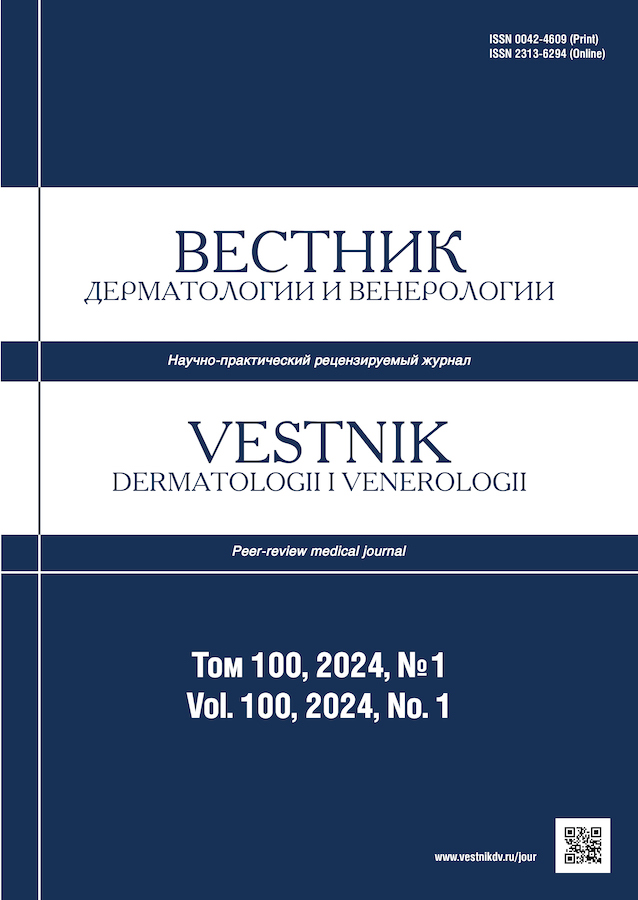
Vestnik dermatologii i venerologii
Peer-review academic medical journal on dermatology, venereology and cosmetology.
About
The journal founded in 1924 is the oldest journal worldwide in the field of dermatology and venereology.
This is an open-access, peer-review international journal that publishes original papers in efficacy and safety of medicines, the analysis of clinical practice, and its compliance with national and international recommendations.
The journal cater for a wide range of readers comprising clinical and medical practitioners of general and advanced medical and clinical research, academicians, researchers, and students, as well as for the international business circle of people in the field that are establishing new skin-care products.
The journal is specially interested in research related to clinical trials, procedural dermatology, patient-centered care and immunodermatology. Papers on research methodology, health care quality, and improving the delivery of patient care, including systematic reviews and evidence-based guidelines, are also welcomed.
Editor-in-Chief
- Prof. Aleksey A. Kubanov, MD, Dr.Sci. (Med.)
ORCID iD: 0000-0002-7625-0503
Founder & Publisher
- State Research Center of Dermatovenereology and Cosmetology, Ministry of Healthcare of the Russian Federation
- Russian Society for Dermatologists and Cosmetologists
Articles types
- reviews
- systematic reviews and metaanalyses
- original research
- clinical case reports and series
- letters to the editor
- short communications
- clinial practice guidelines
APC, Publication & Distribution
- Bimonthly issues (6 times a year)
- Continuoulsly publications online (Online First)
- Platinum Open Access (no APC)
- Creative Commons Attribution 4.0 International (CC BY 4.0) License
- articles in English & Russian
Indexation
- SCOPUS
- BIOSIS Previews
- Russian Science Citation Index (on WoS)
- CrossRef
- Google Scholar
- Ulrich’s International Periodicals Directory
- WorldCat
Current Issue
Vol 100, No 1 (2024)
- Year: 2024
- Articles: 10
- URL: https://vestnikdv.ru/jour/issue/view/107
- DOI: https://doi.org/10.25208/vdv.1001
Full Issue

HEALTH ORGANIZATION
Analysis of the epidemiological situation and dynamics of the incidence of sexually transmitted infections in the Russian Federation over a ten-year period (2012–2022)
Abstract
Sexually transmitted infections (STIs) are socially significant diseases and require close attention due to the multifactorial causes that influence their spread. In 2012–2022, the Russian Federation maintained a downward trend in the incidence of STIs (from 267.6 to 91.3 cases per 100 thousand population), established since 1998 in all age groups. In 2022, compared to 2012, the incidence rates decreased: syphilis — by 42.7%; gonococcal infection — by 77.7%; trichomoniasis — by 75.8%; chlamydial infections — by 72.1%; anogenital herpetic infection — by 51.2%; anogenital (venereal) warts — by 36.5%. But at the same time, in 2021 and 2022, there was an increase in the incidence of syphilis and gonococcal infection: compared to 2019, the increase in the incidence of syphilis was 25.9%, and that of gonococcal infection — 5.2%. The increase in the incidence of syphilis was largely due to an increase in this indicator in the Central (from 18.1 to 37.3 cases per 100 thousand population) and Northwestern (from 14.5 to 16.2 cases per 100 thousand population) federal districts ( FO). An increase in the incidence of gonococcal infection in 2022 compared to 2019 was observed in the Central (+26.3%), Northwestern (+31.2%) and Ural (+27.6%) Federal Districts.
 8-23
8-23


REVIEWS
Deficient skin proteins rescue of expression in patients with epidermolysis bullosa: efficacy of gentamicin
Abstract
Epidermolysis bullosa is a group of rare hereditary skin diseases based on mutations in the genes of structural proteins of the epidermis and the dermal-epidermal junction. Clinically, epidermolysis bullosa is characterized by the appearance of erosions and blisters on the skin and mucous membranes in response to any minor impact. Currently, the treatment of epidermolysis bullosa is only symptomatic. Pathogenetic methods of the epidermolysis bullosa therapy are under development. One of the new possible pathogenetic directions in the treatment of epidermolysis bullosa is aminoglycoside antibiotics (gentamicin, geneticin, paromomycin). A number of studies have shown the ability of gentamicin to promote readthrough terminating codon and resume the synthesis of type VII collagen in keratinocytes and fibroblasts in patients with epidermolysis bullosa with nonsense mutations in the COL7A1. The review presented the possibilities of gentamicin therapy for patients with epidermolysis bullosa, describes the mechanism of its action, summarizes data from clinical trials.
24-30
Langerhans cells and gamma delta Т-lymphocytes in the pathogenesis of psoriasis
Abstract
Psoriasis is a frequently occurring inflammatory skin disease. Fundamental research into the pathogenesis of psoriasis has significantly expanded our understanding of skin immunology, which has enabled the introduction of innovative and highly effective therapies. Psoriasis is a largely T-lymphocyte-mediated disease in which activation of innate immune cells and pathogenic T cells leads to inflammation and hyperproliferation of keratinocytes. Langerhans cells like dendritic cells (DCs), which play an important role in the immune system, are mainly distributed in the epidermis. Since human and mouse skin DC subpopulations share common ontogenetic characteristics, we can further investigate the role of DCs in psoriatic inflammation in mice. γδT cells are an unconventional population of T-lymphocytes that play an indispensable role in host defense, immune surveillance, and immune system homeostasis. Although γδT cells constitute only a small fraction of the total T cell pool, emerging evidence suggests that aberrantly activated γδT cells may play a role in the pathogenesis of psoriasis. Dermal γδT cells are the major IL-17-producing cells in the skin that respond to IL-23 stimulation. In addition, γδT cells have characteristics of memory cells that mediate repeated episodes of psoriatic inflammation. This review discusses the mechanisms by which Langerhans cells and γδT cells participate in the pathogenesis of psoriasis.
31-37
Early diagnosis of skin oncologic diseases using artificial intelligence technologies
Abstract
The last decade has seen significant progress in computer-aided image analysis and recognition, with modern computer-aided diagnostic algorithms not only catching up with, but in many aspects surpassing human abilities. At the heart of this breakthrough is the development of deep convolutional neural networks, which have given a new impetus to medical diagnosis, particularly of skin cancers. In this paper, we analyzed photo-based skin disease classification systems developed using algorithms based on deep learning convolutional neural networks. Such methods have been variously reported to enable automated diagnosis of skin neoplasms with high sensitivity and specificity. A disease that requires more detailed analysis of graphic images — skin melanoma — was chosen as the main object of study. Early diagnosis of melanoma is of great socio-economic importance, as in this case the prognosis of patients is significantly improved. The aim of this work is to analyze the results of artificial intelligence (AI) applications in dermatology, especially in the context of early detection of skin melanoma. Scientific articles were searched in PubMed, Scopus and eLIBRARY databases using the keywords “convolutional neural networks”, “skin cancer” and “artificial intelligence”. The depth of the search was 10 years. The final analysis included 38 sources where the results of our own research were presented. The advantages of artificial intelligence methods for dermatologists were analyzed. Artificial intelligence can significantly assist dermatologists in developing visual neoplasm diagnosis skills and improve diagnostic accuracy. The use of AI to process dermatoscopic data in conjunction with the analysis of anamnestic and clinical information from medical records will reduce the burden on the healthcare system through correctly diagnosed benign skin tumors. All of this promises to have a significant impact on the future development of dermatovenerology.
38-46
ORIGINAL STUDIES
Assessment of the quality of life in patients with onychomycosis and mycosis of the feet with concomitant non-alcoholic fatty liver disease against the background of complex therapy
Abstract
Background. Сurrently, much attention is paid to the quality of patients, which is a promising direction of life, allowing to put a complete and objective picture of the disease, determine the most stable method of treatment, and evaluate its results.
Aims. To evaluate the effectiveness of complex therapy in patients with onychomycosis and mycosis of the feet with concomitant non-alcoholic severe liver disease (NAFLD) using a modified questionnaire-questionnaire of the combined index of quality of life (QL-Index).
Methods. The combined index of quality of life (QL-Index) was determined in patients with onychomycosis and mycosis of the feet with with concomitant NAFLD before and after complex therapy.
Results. Analysis of the results of assessing the presence of a combined index of quality of life in 117 patients with onychomycosis and foot mycosis with concomitant NAFLD before treatment showed that the presence of onychomycosis and mycosis of the feet in the majority of respondents has a strong impact on the lives of the respondents (69.2%). After the complex treatment, according to the results of the combined questionnaire-questionnaire of the quality of life index, it was revealed that social activity in patients with onychomycosis and foot mycosis with concomitant NAFLD increased, and the psycho-emotional state improved. The quality of life of patients has improved, which significantly increased the effectiveness of this complex treatment.
Conclusion. The high efficacy and safety of complex therapy, which included the use of the systemic antimycotic itraconazole in combination with external antifungal drugs, a hepatoprotector and a prebiotic in patients with onychomycosis and mycosis of the feet with concomitant NAFLD.
47-55
Experience with the fixed combination of benzoyl peroxide and clindamycin in acne therapy
Abstract
Background. Acne is one of the most common dermatoses, affecting more than 9% of the world’s population. Acne negatively affects the patient’s quality of life and self-esteem, often leading to the development of anxiety and depression. The combination of pharmacological drugs with different mechanisms of action in one external dosage form can provide higher therapeutic efficacy.
Aims. To evaluate the effectiveness and tolerability of a combination drug with a fixed dose of clindamycin 1% and benzoyl peroxide 5% in the treatment of patients with mild to moderate papulopustular acne.
Methods. A single-center, open-label, observational, prospective study lasting 6 weeks was performed, which included 40 patients with mild to moderate papulopustular acne who received a gel with a fixed dose of clindamycin 1% and benzoyl peroxide 5% once a day. A clinical assessment of the effectiveness of therapy was carried out, PH, greasiness and moisture of the facial skin were measured, and the dynamics of the dermatological quality of life index was studied.
Results. The proportion of patients who showed significant improvement at the end of 6 weeks of treatment was 32/40 (80%). The total proportion of patients who showed significant and moderate improvement at the end of therapy reached 36/40 (90%).
Conclusion. The results obtained showed the high therapeutic effectiveness of the gel with a fixed dose of clindamycin 1% and benzoyl peroxide 5% in the treatment of mild to moderate papulopustular acne.
56-62
Possibilities of using topical retinoids and azelaic acid in acne therapy
Abstract
Background. Acne is a common, complex and multifactorial inflammatory disease that results from a variety of causes. Acne therapy is an urgent problem of dermatocosmetology. The clinical manifestations of dermatosis can be alleviated, and its long-term consequences can be prevented by early diagnosis and timely initiation of treatment, affecting multifaceted all parts of the pathogenesis.
Aims. To evaluate the clinical efficacy and safety of the use of monotherapy of 0.1% adapalene cream (Adaclean) with combined external therapy of 0.1% adapalene cream (Adaclean) with 20% azelaic acid cream (Azix-Derm) in the treatment of mild to moderate acne.
Methods. Under our supervision at the Department of Plastic Reconstructive Surgery, Cosmetology and Regenerative Medicine of the State Budgetary Educational Institution of Higher Professional Education Rost of the State Medical University of the Ministry of Health of Russia, the clinics “Ekaterininskaya” and “MIR-O-MED” there were 50 patients aged 12 to 50 years (18 (36%) men and 32 (64%) women) with mild and moderate acne. Patients with comedonal acne, in the absence of multiple inflammatory elements, which made up group 1 of observation (n = 16), were prescribed Adaclean cream, 1 time per day (evening) against the background of skin care. In the group with mild to moderate papulo-pustular acne and post-inflammatory changes (group 2, n = 34), patients were prescribed a combination of 0.1% adapalene cream and 20% azelaic acid cream (Adaclean (evening) and Azix-Derm (morning)). The follow-up period was 6 months.
Results. Total clinical remission after 6 months therapy was achieved in 70% of cases, a significant improvement — in 28%, improvement — in 2%. In patients with a comedonal form of acne against the background of monotherapy with Adaclean cream, clinical recovery was obtained in 44% of patients, a significant improvement — in 50%, and an improvement — in 6%. In patients from the group of papulo-pustular acne of mild to moderate severity, after 3 months the use of complex therapy Adaclean and Azix-Derm noted almost complete relief of the inflammatory process; after 6 months therapy clinical recovery was recorded in 58%, significant improvement — in 36%; 6% showed partial improvement, which is associated with irregular use of drugs and skin care products. After 6 months combined treatment was able to achieve regression of dyschromia in 18–46% of patients, atrophic scars — in 5–22%, which significantly improved the results of therapy and made it possible to achieve a good cosmetic effect.
Conclusion. The combined use of drugs for external use of adapalene (Adaclean) and AK (Azix-Derm) in the treatment of papulo-pustular acne of mild and AK (Azix-Derm) in the treatment of papulo-pustular acne of mild and moderate severity can significantly increase the effectiveness of treatment, achieve a stable clinical effect and remission of the disease, as well as improve the quality of life of patients.
63-72
GUIDELINES FOR PRACTITIONERS
Hyperhidrosis: problems and solutions
Abstract
The functional role of sweating is not limited only to thermoregulation and excretion. There are other functions of it — the ability to enhance and maintain hydration and barrier function of the skin. Excessive sweating can lead to an exacerbation or cause many skin diseases, form psychological discomfort in a person due to wet clothes or an accompanying unpleasant odor. Primary hyperhidrosis may be an autosomal dominant genetic disease. Secondary, usually generalized hyperhidrosis is often associated with drug effects on the body or a systemic disease. The following approaches are used in the treatment of hyperhidrosis: 1) blocking the release of sweat to the skin surface (aluminum salts and formaldehyde); 2) physiotherapy (iontophoresis); 3) destruction of sweat glands and cessation of sweat production (excision of a skin flap with subcutaneous fat, curettage, microwave technology, etc.); 4) termination of the signal from the central nervous system to the sweat glands (transthoracic endoscopic sympathectomy, percutaneous radiofrequency sympathectomy, botulinum toxin injections, systemic anticholinergic drugs). External remedies for excessive sweating include the Russian drug Formagel®, containing 3.7% formaldehyde. This drug is a non-invasive, easily doable, effective, safe method of treating hyperhidrosis.
73-84
CLINICAL CASE REPORTS
Difficult path to the diagnosis of chromomycosis
Abstract
Chromomycosis is a slowly occurring mycosis of subcutaneous adipose tissue and skin. Most often, cases of the disease are recorded in countries with a tropical and subtropical climate. In the Russian Federation, the disease occurs sporadically. Very rarely (2 cases out of 100) malignant transformation into squamous cell carcinoma occurs. The article presents a clinical case of chromomycosis. A description is given of a patient in whom squamous cell carcinoma was detected at the onset of the disease, which was the reason for treatment by oncologists. Six months later, the patient had a relapse in the area of the postoperative scar and a focus in the area of the right hand. Repeated biopsy with histological examination made it possible to establish the correct diagnosis. Interest in the above clinical case was caused by the detection of chromomycosis in a resident of the city of Saint Petersburg, who was not in endemic areas, was not engaged in agricultural work, and denied the primary injury. Our patient experienced a rapid malignancy of the focus, after surgical treatment, a recurrence of deep mycosis occurred. A good effect was obtained from systemic antimycotic therapy.
85-92
Anticytokine therapy with interleukin-17 in patients with moderate and severe psoriasis
Abstract
Clinical observations of three patients aged 26, 43 and 37 years with severe psoriasis and psoriatic arthritis are presented. Clinical examples show the experience of effective treatment of patients with psoriasis and psoriatic arthritis using anti-cytokine therapy with an interleukin-17 inhibitor, initiated when the disease progresses. The clinical picture of the presented observations was characterized by an aggressive course of the skin and articular process, torpidity to basic therapy, despite the young age of the patients. It has been shown that the early termination of the progression of the inflammatory process in psoriasis with the use of genetically engineered biological therapy with secukinumab leads to a decrease in symptoms, both on the part of the skin and manifestations of the disease on the part of the musculoskeletal system. The high efficacy and safety of the drug allow complete control of the disease and improve the quality of life in patients suffering from severe forms of dermatosis.
93-103
 СМИ зарегистрировано Федеральной службой по надзору в сфере связи, информационных технологий и массовых коммуникаций (Роскомнадзор).
 Регистрационный номер и дата принятия решения о регистрации СМИ: серия ПИ № ФС 77 - 60448 от 30.12.2014.